How to turn a novel into a visual novel
What changes when prose becomes a visual novel, how to prepare the manuscript, and how to adapt it with Pominis chapter by chapter, checked against the book.
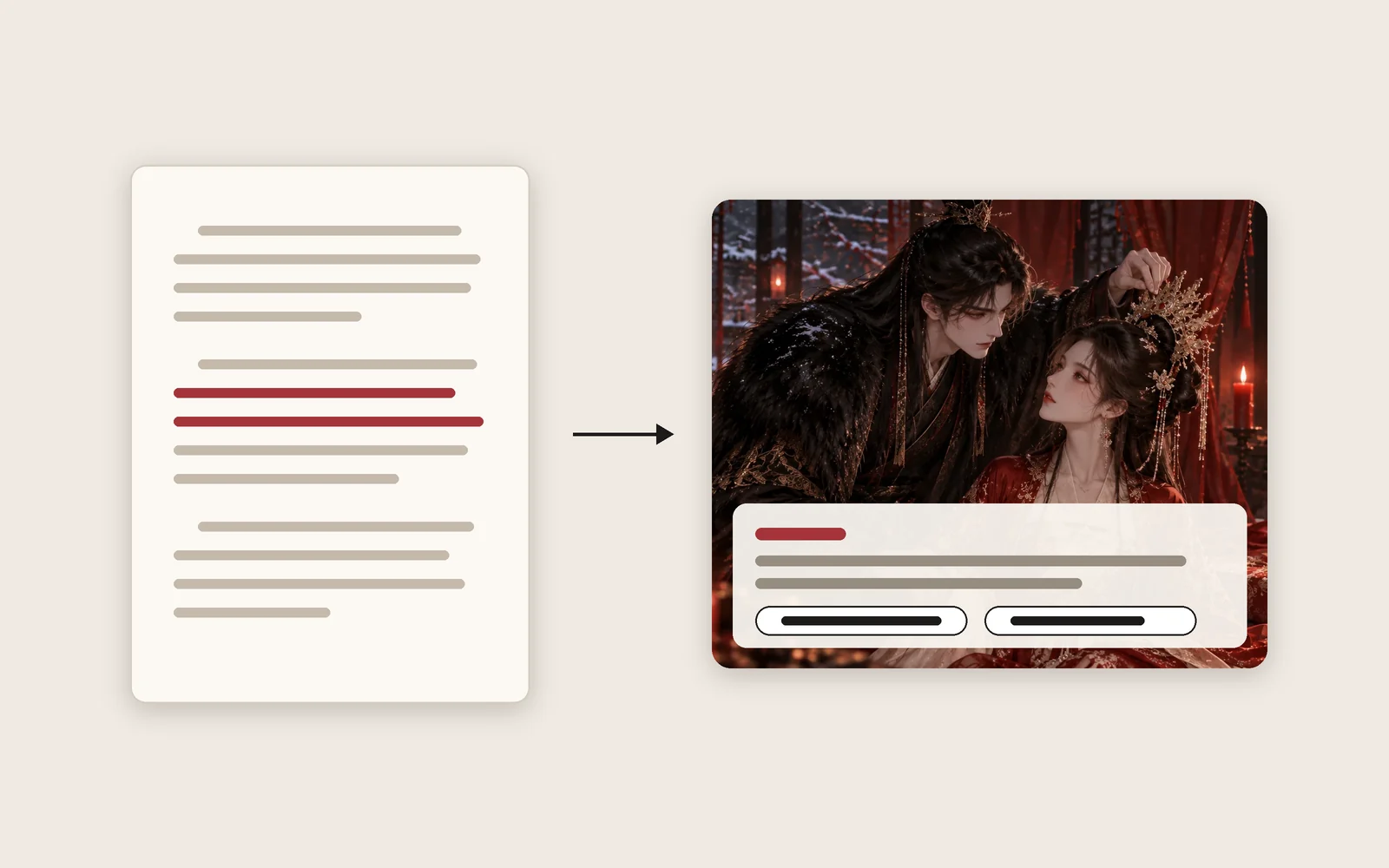
A novel and a visual novel tell a story with different tools. The novel has a narrator who can stop time, explain a feeling, and summarise a year in one sentence. A visual novel has a picture, a face, a line of dialogue and a moment where the reader has to choose. Turning one into the other is less like converting a file and more like adapting a book for the stage.
This guide walks through that adaptation: what has to change, how to get the manuscript ready, how to bring it into Pominis and say how close to the book you want to stay, and how to check each chapter against the original. It works for your own novel, a story you are still writing, or a public-domain book you love.
What changes when prose becomes a visual novel
Most of the work is moving information out of the narrator’s voice and into things the player can see, hear and decide. Four changes come up in almost every chapter.
- Inner monologue becomes a face and a line. “She was terrified but would not show it” turns into a steady voice, a hand gripping the chair, and a portrait that does not quite match the words.
- Description becomes the scene. Paragraphs about a room, the weather or a street become one background picture, so the text can stay on what people say and do.
- Summary becomes a played moment or a cut. “Over the next weeks they grew close” either becomes one scene that shows it, or a short line between scenes. Visual novels are bad at montage and good at single moments.
- Turning points become choices. The places where your protagonist hesitates, lies, trusts someone or walks away are where the player gets to decide. Not every chapter needs many; one or two that matter are better than five that do not.
A worked example: one passage, one scene, one choice
Here is a short passage from Arthur Conan Doyle’s “The Adventure of the Speckled Band” (1892, public domain), the moment Helen Stoner first speaks in Baker Street, followed by one way to stage it. The scene version is our own hand-written illustration of the shape, not Pominis output.
“It is not cold which makes me shiver,” said the woman in a low voice, changing her seat as requested.
“What, then?”
“It is fear, Mr. Holmes. It is terror.” She raised her veil as she spoke, and we could see that she was indeed in a pitiable state of agitation, her face all drawn and grey, with restless frightened eyes, like those of some hunted animal.
[Scene: Baker Street sitting room, early morning. Fire just lit.]
[Helen Stoner, veiled, moves to the chair by the fire.]
HOLMES: You are shivering. Come nearer the fire.
HELEN (low): It is not cold which makes me shiver.
HOLMES: What, then?
[She lifts the veil. Portrait: face drawn and grey, eyes never still.]
HELEN: It is fear, Mr. Holmes. It is terror.

CHOICE (you are Watson)
  > Pour her a cup of coffee and wait.
  > Ask who she is afraid of.
Notice what moved where. Doyle’s description of her face became an instruction for the portrait. Holmes’s observation stayed as dialogue because it is in character. The choice sits right after the reveal, and both options are true to Watson; they change what Helen says first, not the plot of the story. That is a good default for a faithful adaptation: choices that colour a scene, with bigger branches saved for the moments where the book itself turns.
Prepare the manuscript
You do not need a special format. Plain prose works, and so does a screenplay. A little preparation makes the first chapter much closer to the book.
- Start with a chunk, not the whole book. The first chapter or the first few chapters are enough to begin; the story continues chapter by chapter after that.
- Write a short cast list at the top: each main character’s name, age, look and one line about how they speak. Names are the thing an adaptation most often gets wrong.
- List what must not change: the ending, a line of dialogue, a relationship, a twist. Anything not on the list is open to adaptation.
- Decide who the player is. Most visual novels put the player in the protagonist’s shoes. If your book is told by an observer, like Watson, say whether the player is the observer or the hero.
Bring it in and say how faithful it should be
On the Pominis homepage, open ⊕ under the box and choose Import a script or novel, or paste the text straight into the box. Text files, Markdown, PDF and Word documents can be attached, several at a time. Pick Visual novel or Phone chat as the format, then add a sentence or two about how you want it adapted.
That sentence matters more than anything else. A faithful adaptation keeps the plot, names and key lines and adds choices around them. A loose adaptation takes the world and characters and lets the story go somewhere new. Both are fine; the agent just needs to know which one you want. Two examples:
Faithful: This is chapter 1 of my novel. Keep the characters, their names, the order of events and the last line. Stay close to the original dialogue. The player is Mara. Add two or three choices that change how scenes play out, not what happens.

Loose: Use the world and the three main characters of this novel, but start a new case. Keep their personalities and history. The player is the new apprentice, a character who is not in the book.
What you get for chapter 1
Before anything is written you see the credit cost, and you are only charged once the chapter exists. Then the characters are drawn first, so each one keeps the same face and clothes in every scene. After that the chapter is written: scenes with background pictures, dialogue and narration, and choices that lead to different moments. You can watch it come together scene by scene or leave and come back when it is ready. When it is done, you play it in the browser, the same way a reader would.
Check each chapter against the original
AI adaptation is fast, but it can still drop a detail, merge two minor characters or move a line to the wrong person. Play the chapter with the book open and check four things.
- Names and relationships: who is whose sister, who knows what, who has met whom.
- The lines you care about: the ones you listed as fixed should be there, word for word.
- Order of events: nothing from chapter 3 of the book should appear in chapter 1 of the game unless you asked for it.
- The choices: each option should be something your character could believably do, and the result should fit the book.
To fix something, tell the Studio in one sentence (“Helen should not mention her sister until the second scene”), or open the editing tools and change a scene directly.
Continue with the next chapter, then share
At the end of a chapter Pominis offers three directions for the next one, and you can always write your own. For a faithful adaptation, write your own: describe the next part of the book, or attach the next chapter of the manuscript, and the story continues from where the player left it, remembering the choices they made.
When you are happy with it, choose who can play: public, anyone with the link, or only you. Readers play in their browser without installing anything. If you allow it, other people can also press Make your version on the story page and build their own take on your adaptation; yours stays as it is, and theirs credits the original.
Common pitfalls
- Pasting a whole trilogy at once. Long books work best in parts, one chapter of the game at a time.
- Keeping every paragraph of description. If the background picture shows it, the text does not need to say it.
- Choices with no consequence and choices that break the book. Aim for options that change tone, trust or information, and keep the big turns for the book’s own turning points.
- Adapting a book you do not have rights to. Use your own writing, work in the public domain, or work whose author has said yes.
Questions about adapting a novel
Can I upload my whole novel? You can attach long files, but the game is made one chapter at a time. Start with the opening and bring in later parts as you continue.
Will it rewrite my story? Only as much as you ask. Say what must stay, and play each chapter to check; anything that drifts can be fixed with one sentence or in the editor.
Does it work for Chinese, Japanese or other languages? Write and upload in the language you want the story in; Pominis writes it in that language.
Is it free? You can start free: new accounts get 200 credits, and the free plan adds 120 every week. A standard chapter costs 100 credits, and playing stories is free.