Comparisons · 4 min read
Ren'Py alternative for visual novel prototypes
Ren'Py is a free, open-source engine. Compare its script-first workflow, cost, and builds with a browser-based AI workflow for playable prototypes.
Ren'Py remains a strong choice when you want an open-source engine, a script you edit directly, and detailed control over a downloadable visual novel. Looking for a Ren'Py alternative usually means something narrower: you want to get from an idea to a playable draft in a browser before you commit to a production pipeline.
Pominis starts from a premise, a script, or a reference image and drafts scenes, characters, dialogue, choices, and visuals in one web workspace. That solves a different problem from Ren'Py. It is a faster way to find out whether a story works, not a replacement for every engine feature.
Pominis and Ren'Py at a glance
- Starting point: Pominis starts from a premise, a script, or a reference image; Ren'Py starts from a local project and a script you write.
- Structure: Pominis drafts scenes, choices, and endings you can review on a canvas; Ren'Py gives you direct control over the script and runtime logic.
- Art: Pominis generates and edits characters and scenes in the same workspace; with Ren'Py you bring or create the assets yourself.
- Output: Pominis publishes a hosted story link; Ren'Py builds for desktop and mobile platforms and can also produce a web build.
- Cost: Ren'Py is free; Pominis is free to publish, while AI generation uses credits.
What Ren'Py does well
- Free, open-source software with a mature script language and a large creator community.
- Direct access to project files, Python extensions, custom screens, variables, and game systems.
- Builds you ship yourself, on the platforms you choose, under terms you control.
Those strengths matter most once the story is settled. A team that already knows its route structure, art pipeline, and release target loses little by working in script, and gains a great deal of control.
What changes when the first draft is in a browser
Before the story is settled, the expensive part is not writing code; it is finding out that a route does not work after the art is made. A browser workflow shortens that loop. You describe the premise, the agent drafts the scenes and the art, you play the draft, and you send a link to a collaborator who does not need to install or configure anything.
The trade is control. In Pominis you shape the story through the agent, the canvas, and the scene editor, not through code, so custom screens, minigames, and engine-level systems are out of reach.
Cost and export
Ren'Py costs nothing to use, and the only limits on distribution are the ones you set. Pominis is free to start and to publish public or private stories, but generating images, scene videos, and other AI output spends credits: the free plan includes daily credits, and paid plans include more. Unlisted publishing and exporting a story as HTML need a paid plan. Before you commit to either tool, check the publishing, export, and commercial terms against the release you actually plan to make.
When to stay with Ren'Py
- Your project depends on custom Python systems, unusual interface behavior, or specific build targets.
- Your team is comfortable managing scripts, assets, version control, and local builds.
- You are ready to ship a finished downloadable game rather than test an early concept.
Using both on one project
A common sequence is to prototype the premise and route structure in Pominis, play it with a few readers, and then rebuild the proven story in Ren'Py for a full release. The reverse also works: a Ren'Py writer can use Pominis to try an alternate scene or a character direction as a quick playable pitch. When a prototype moves on to Ren'Py, carry over the decisions, not the files: Pominis does not export Ren'Py projects.
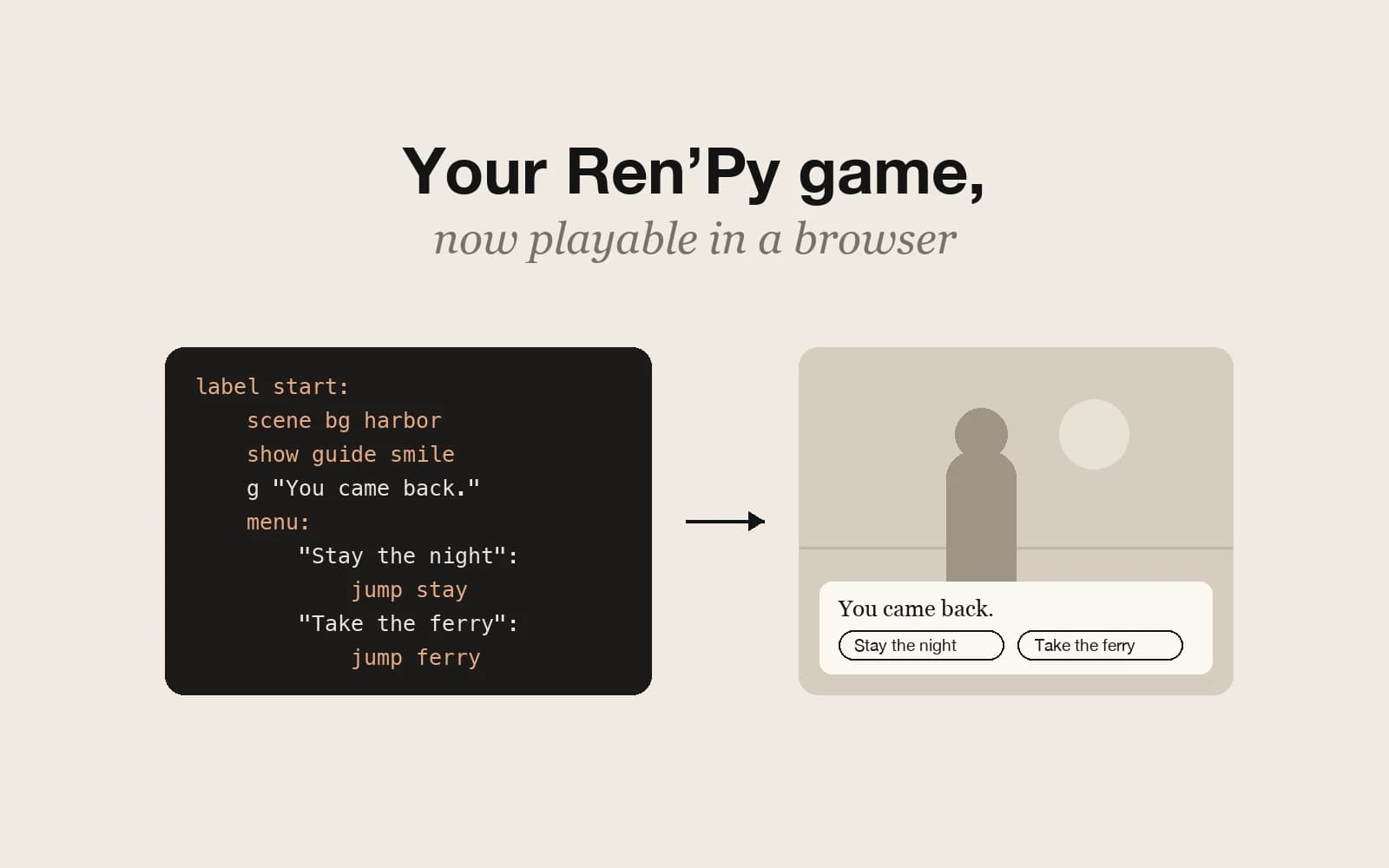
The other direction is now direct. If you already have a Ren'Py game, Import a game turns a .zip with its .rpy scripts into a new Pominis story, with its dialogue, choices, variables, endings, art, and music. Custom screens, minigames, sound effects, and complex Python do not come across, so treat the result as a playable starting point to revise, not a finished port.