Text message stories you can play in a browser
How chat-style stories work, how to pace messages and turn replies into choices, and how to make one in Pominis that anyone can play on the web.
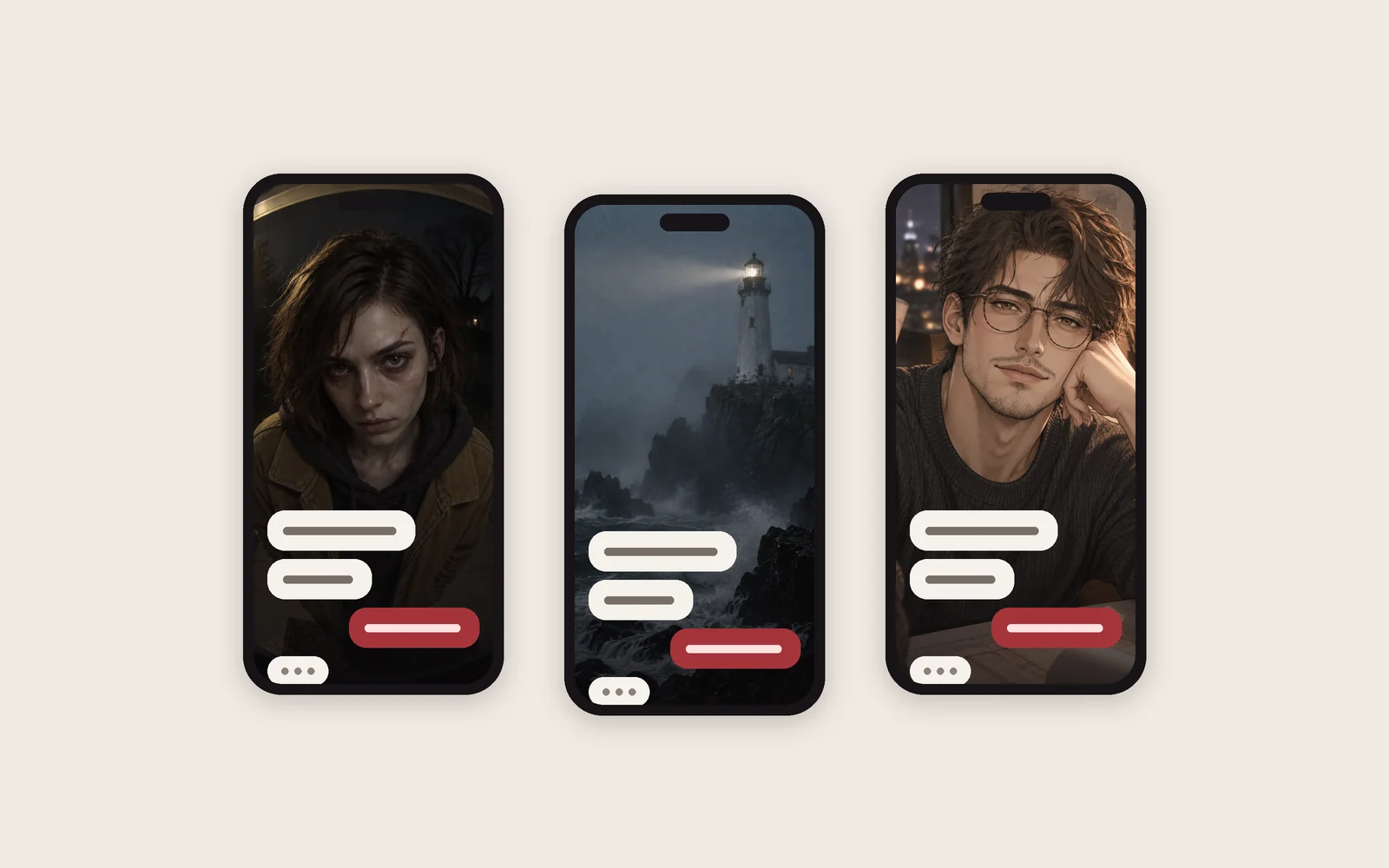
A text message story is told entirely through a phone: a chat thread, a few photos, a notification on a locked screen at 2 a.m. It is one of the most natural ways to tell a story to people who read on their phones, because it looks exactly like what they already do all day.
Most text-story apps are built to record a fake chat as a video for social media. That is a different thing. In an interactive chat story, the reader is inside the conversation and picks what to say back. This guide covers how that kind of story works, how to pace it, and how to make one with Pominis that anyone can play in a browser, with no app to install.
What a playable chat story looks like
Two examples from the Pominis team, one thriller and one romance, both told only in messages. Open one and play the first few minutes before reading on; it will make the rest of this guide easier to picture.

The Glass Between Us
Phone chat · 3 chapters · EnglishAt 2:17 a.m. your sister, missing for a year, texts: don’t open the door, that is not me outside. Then the doorbell camera sends her face.

Possession Is Nine-Tenths
Phone chat · 2 chapters · EnglishA late-night text to your ex reaches a stranger who wants to negotiate. A wrong-number romance that turns out to be on your street.
Pacing: message length, pauses and “read”
In a visual novel the reader sets the pace by clicking. In a chat story the other person seems to set it, and that is where most of the tension comes from. Four tools do most of the work.
- Short messages. One thought per bubble. A long paragraph in a chat reads as a letter; three short bubbles in a row read as someone typing fast and scared.
- The typing indicator. In the Pominis player, the other person’s messages arrive after a short typing pause, longer for longer messages. A typing indicator that appears and then stops is a whole beat of story on its own.
- Read and unanswered. A message that has been read but not answered says more than most lines of dialogue. Leave gaps on purpose.
- Photos and the lock screen. A photo can reveal what words would only describe, and a notification on a locked screen is the classic way to open a chapter.
Your replies are the choices
In a chat story you do not pick “Go left” or “Go right”; you pick what to type back. That makes choices feel personal, and it means every option should sound like a person, not a menu. Here is a short hand-written illustration of the shape:
UNKNOWN NUMBER  01:12
you left your scarf at the station

UNKNOWN NUMBER  01:12
[photo: a grey scarf on a bench]

UNKNOWN NUMBER  01:13
want me to keep it safe for you?

YOUR REPLY
  > who is this
  > that is not my scarf
  > [leave it on read]
All three are honest reactions, and each opens a different conversation: the first asks for a name, the second starts a mystery, the third lets the silence work. Saying nothing is a valid choice in a chat story, and often the most interesting one.
How to start one in Pominis
On the Pominis homepage, sign in, switch the format under the box from Visual novel to Phone chat, and write one idea: who is texting whom, and what is wrong. You can also import a story or a script and pick Phone chat to adapt it into messages. Pominis then writes chapter 1 as a chat story: it draws the people you will talk to first, then writes the thread, the photos and the replies you get to choose from.
Play it on your phone or in a desktop browser, where it opens inside a phone screen. At the end of the chapter, pick one of three directions for the next one, or write your own, and the story continues. If a story needs scenes as well as messages, the story settings also offer Phone chat + visual novel, so the plot can step out of the phone when it needs to.
A good chat-story idea answers four questions in a line or two: who you are, who is on the other end, how you know each other (or why you do not), and what is wrong tonight. “I am a night-shift nurse; a patient discharged last week keeps texting me from the ward he left” is enough to write a whole first chapter. Say how it should feel, too: tense, funny, slow-burn. The more specific the first message you imagine, the better the thread that comes back.
Ideas that suit a chat
- A wrong number that will not go away.
- Messages from someone who should not be able to send them: a missing friend, a phone that was buried, next week.
- A group chat where one member is lying, and you have to work out who.
- A long-distance relationship told across time zones, where the gaps between replies are the story.
What these have in common: the reader cannot see the other person, so every message is a clue and every silence is a question.
Publish and share
When the story is ready, choose who can play: public, anyone with the link, or only you. Readers open the link and play in the browser, on a phone or a computer, without installing an app. If you allow remixes, readers can press Make your version on the story page to write their own take, and yours stays as it is.
Questions about chat stories
Can I play these on a computer? Yes. On a desktop browser the chat opens inside a phone frame.
Can I export a video of the chat? No. Pominis chat stories are made to be played, with choices, rather than recorded as videos.
Do I need to write every message myself? No. One idea is enough; Pominis writes the chapter, and you can change any part of it by saying what you want or by editing it directly.